
 Español
 Русский
 Deutsch
 Português
 Français
 Italiano
Protests in Paris: Massive student marches open a critical front for Macron
The student protests brought together more than 266,000 people in France. The government of Macron analyses responses to the growing social pressure.

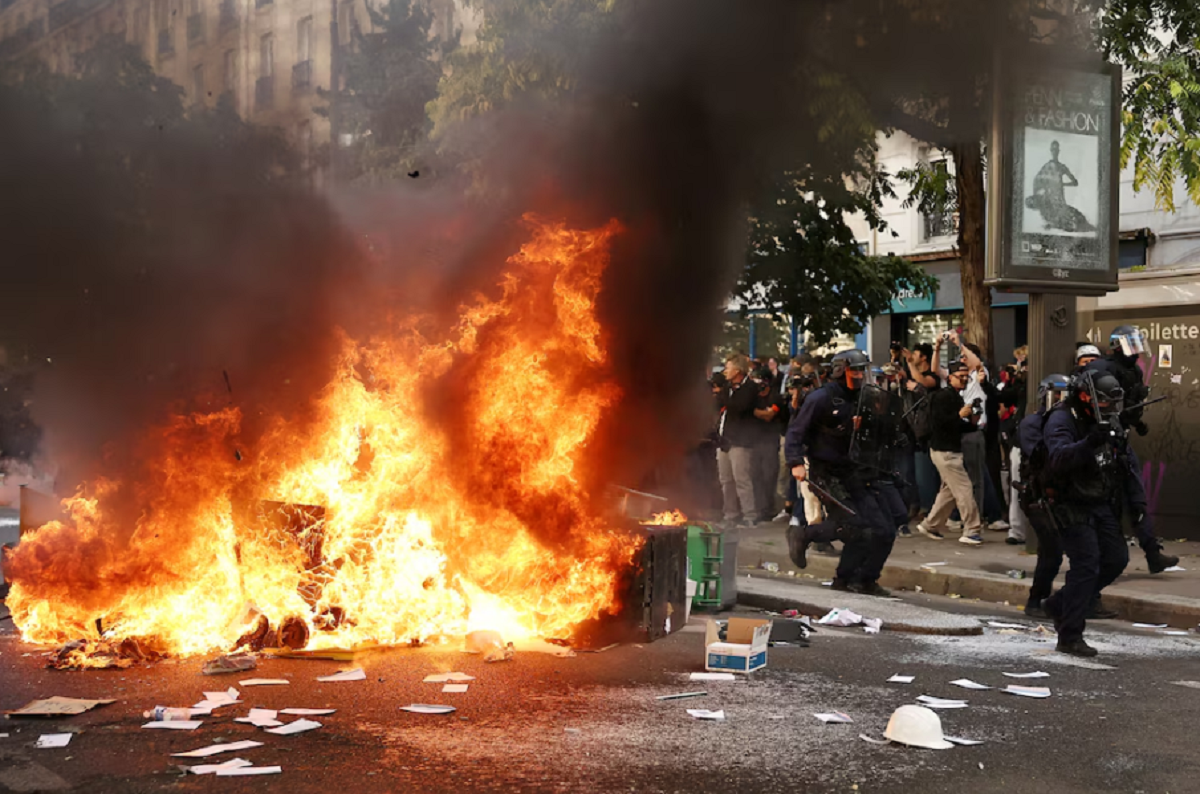
France lived a day of intense social unrest after more than 266,000 people marched in different cities of the country, according to estimates of the Ministry of the Interior, a figure that the organizing groups raised to 450,000. The day of strike and protest, led by groups of secondary and university students, is opposed to budget cuts in the public sector and requires profound reforms in the conditions of study.
In the capital, Paris, the main column brought together 56,000 people according to the security forces and more than 100,000 according to the convening entities. The march traveled between the Plaza de la República and the Plaza de la Nación, in the framework of a strong operation that included the deployment of thousands of police and gendarmerie personnel, in addition to the preventive closure of ten stations on the metro network.
The conflict, which began in mid-September at a school in the Parisian periphery, expanded rapidly to 40 per cent of the country & apos; s 3,700 secondary education centres. The protests have the formal support of teaching unions and political parties on the left bow.
Elysées response and Executive announcements
In view of the magnitude of the discontent on the streets, President Emmanuel Macron led an emergency meeting at the Elysée Palace with several of his ministers to assess containment alternatives. For his part, Prime Minister Sébastien Lecornu is preparing an official speech to detail the government’s position on the educational demands and fiscal situation in the country.
As an immediate measure, the Executive announced the suspension of the classes for a half-day between Wednesday and Friday, allocating that time space for the management teams of the institutions to organize internal discussions with the student. The government also launched a five-axis platform to channel academic claims.
Despite official announcements, student organizations considered the Executive’s initiatives insufficient and ratified the call to maintain the blockades in educational centres and to call for new zonal marches.
Incidents, police questions and legislative debate
The scale of the demonstrations was accompanied by episodes of institutional violence and clashes with the security forces. The day left a balance of 488 arrests and 43 officers injured at the national level. In Paris, 12 injured demonstrators were recorded, including a young man in a state of gravity after falling from the central monument of the Republic Square.
The climate of tension was aggravated by events that occurred in previous days, including the case of a 15-year-old adolescent who was amputated by a hand during clashes in front of a school in Lens, an event under judicial investigation. In parallel, the Justice formally charged a police officer for causing serious mouth injuries to a 14-year-old student during a previous intervention.
Since the start of the mobilizations in mid-September, official records have recorded more than 6,500 arrests, 600 security officers injured and more than 200 students injured, together with material damage to urban furniture and school facilities valued at tens of millions of euros. In the face of the recorded destruction, the Executive seeks to speed up a bill establishing the financial responsibility of parents for the vandals committed by their minor children.
Fiscal tension and political scenario around 2027
The malaise in public education coincides with demands from other sectors of society, such as state employees and farmers, affected by increased costs of basic services and loss of purchasing power. This scenario is in the midst of discussions on the budget draft for 2027, which provides for reductions in public expenditure to deal with a debt of 120% of gross domestic product (GDP).
The international market’s mistrust of the French tax situation had an impact on the return of the 10-year souverain bonds – which reached a rate of 4,745% – and pushed the European currency to low levels compared to the US dollar.
At the political level, the conflict takes place six months after the first round of the 2027 presidential elections. From the head of government, Prime Minister Lecornu accused the party The Intensive France, led by Jean- Luc Mélenchon, of instrumentalizing demonstrations for electoral purposes, while the left-wing opposition reiterates its support for the mobilizations and promotes a national march against the cost of living set for October 17.